 IT
IT
 EN
EN

Fast web, slow help
Prologue
For several days, I have been struggling with Fastweb’s customer support. The booster paired with my NeXXt modem/router – a total piece of junk, I might add – had kicked the bucket, leaving me without internet access in the room I use as a home office.
Working was not an issue, my iPhone easily provided (almost) all the connection I needed. However, many other services rely on the network and were now completely broken.
At first glance, it seems like a minor issue: how hard can it be to report the problem to Fastweb support team and get a replacement booster?
Technical support (?)
Well, it was hard. Phone calls or WhatsApp chats are of little use: whoever answers only suggests turning the router and booster off and on again, or resetting them to factory defaults.1 And this happens even though, as the operator can check remotely every single time, the router works perfectly and the local network is fine. The problem is only the booster, which – no matter how hard I try —- powers on, but for some unknown reason can no longer connect to the modem/router.
Yet every time I get to the point of requesting a replacement booster, the interaction with support inevitably ends with the assurance that “I will be contacted as soon as possible.”
Except that never happens. So I’m forced to try again, explaining everything from scratch because in the meantime the operator has changed, and the new one never has the will, or time, to check their colleagues’ notes or the previous chats.
After two or three rounds, I realize it’s useless to insist. Better to request an upgrade to the new router model, which is supposed to offer better performance and, above all, more flexibility than the NeXXt. It would also be the perfect opportunity to get the ONT mounted on the wall, avoiding loose fiber optic cables trailing around the house.
Also, requesting a plan upgrade is far more tempting for Fastweb: swapping a router or booster is free, but upgrading to a new plan doesn’t come cheap.
Indeed, this time the operator immediately accepts the request and, after some typing on the keyboard, assures me that everything is set and that I’ll be contacted within a few days to arrange a date for the installation of 33the new router. Even the Fastweb app seems to confirm what he’s saying, so I settle in to wait.
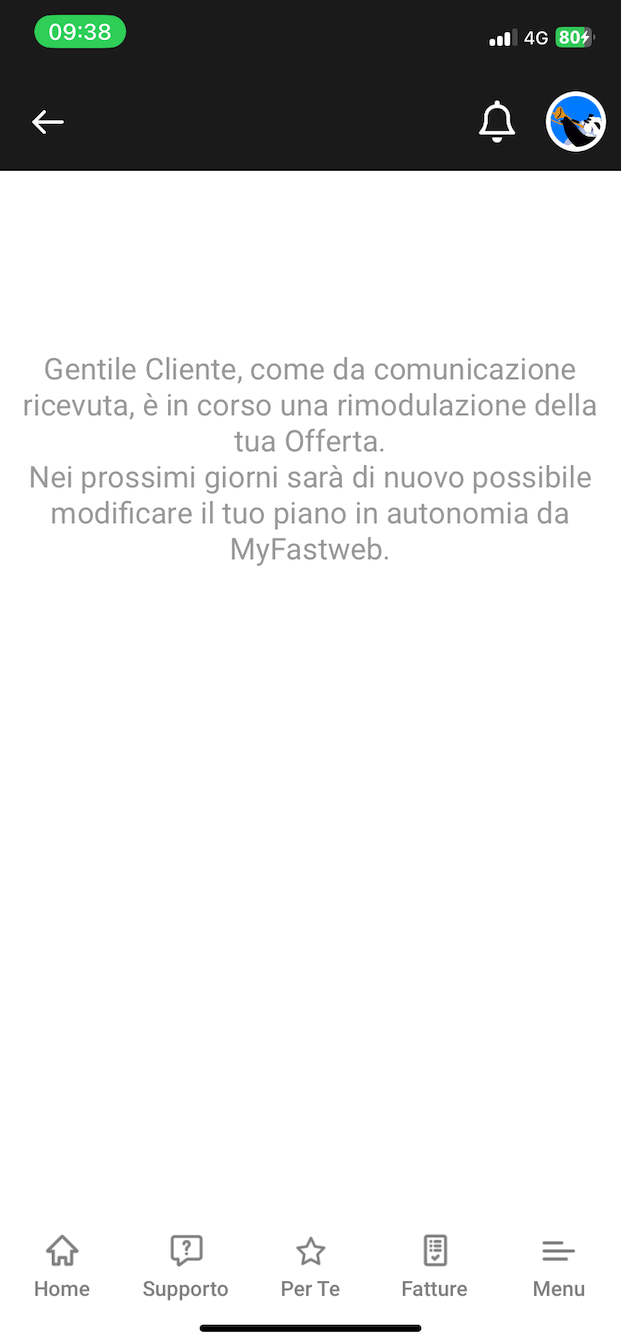
Yet days go by and nothing happens. I contact Fastweb support once more, and yet another operator tells me that she can’t see any record of a plan upgrade request. Why the web app says otherwise is a mystery even to her. The operator kindly promises, however, to forward the request to the technical staff and assures me that I’ll be contacted the next day with the details.
A boomer move
Clearly, nobody contacts me the next day, so I decide to make a boomer move (my daughter’s words) and head to an actual brick-and-mortar Fastweb store.
But physical stores really only exist for boomers like me now. In a store, you can sign up for a new subscription, get tempted by questionable-quality gadgets at jewelry-store prices, or chat with the manager while enjoying some air conditioning after a walk in the sun. But if you need to do anything even slightly more sophisticated, all you can do is… use the Fastweb app or call technical support for the umpteenth time.
Too bad I can’t use the Fastweb app, both on the web and on mobile, because I already have a pending plan modification request!
The lady at the store does her best to help me (and I sincerely thank her for that), but the outcome is still the same. Zero. Or more precisely: the outcome is a promise that I’ll be contacted within 24 hours by Fastweb technicians. Do I need to say that I’m still waiting?
Time to move?
In the meantime, I start looking around for alternatives.
However, ILIAD doesn’t reach my house with the fiber. Vodafone has merged with Fastweb, so it’s not possible to switch between the two.. TIM is out of question, and requires a commitment of at least two years anyway. Sky is almost worse than TIM. Aruba, call me biased, has a name that speaks for itself.2
In the end, I opt for Dimensione, which brings fiber straight to my house, doesn’t require the kind of loyalty that I can reserve only for my wife and, best of all, allows me to use whichever modem/router I want. I’m ready to commit, but first I want to give Fastweb one last chance.
A ray of light
I’ve been fighting fruitlessly for ten days. But it’s Saturday morning and I have some free time, so I request a last phone call from Fastweb. If nothing happens, I’ll sign the contract with Dimensione and never look back.
Yet just like a plot twist in the final minutes of a TV series episode, this time I land an operator who actually knows her stuff (thank you so much, anonymous operator!) and who solves all my problems in a heartbeat. She sends me the new contract to sign in real time and even explains that the plan modification visible on the web app was just an old support ticket stuck in an electronic limbo that would make good old Dante proud.
A couple of days later, they call me back (yes, they actually call me back this time) to schedule the installation of the new equipment. I pick the earliest available slot, and so, finally, after fifteen days of struggling, my home network is 100% working again.
No wall-mounted ONT, though. According to the technicians who came to my house, that it’s reserved for people who use their own modem/router. I’m not going to worry about that now, but this an upgrade worth doing as soon as possible.
Epilogue
A few years ago, what happened would have been called a textbook example of a Catch-22,3 where bureaucracy cooks up rules specifically designed to trap the user in an endless loop of waiting, wearing them down until they forget why they even reached out in the first place.
In recent years, people defines that more specifically as enshittification, a term coined by Cory Doctorow to describe the evolution of online services that, once they lock in a loyal user base, systematically shift their focus toward maximizing profits at the expense of their customers.
Either way, the core idea here remains the same: customer support is becoming increasingly complex and useless, with chatbots that seem coded by mentally challenged people, background music that would make a deaf person cringe, and support operators who can (or will) do very little because, at the end of the day, “the computer makes all the decisions.”
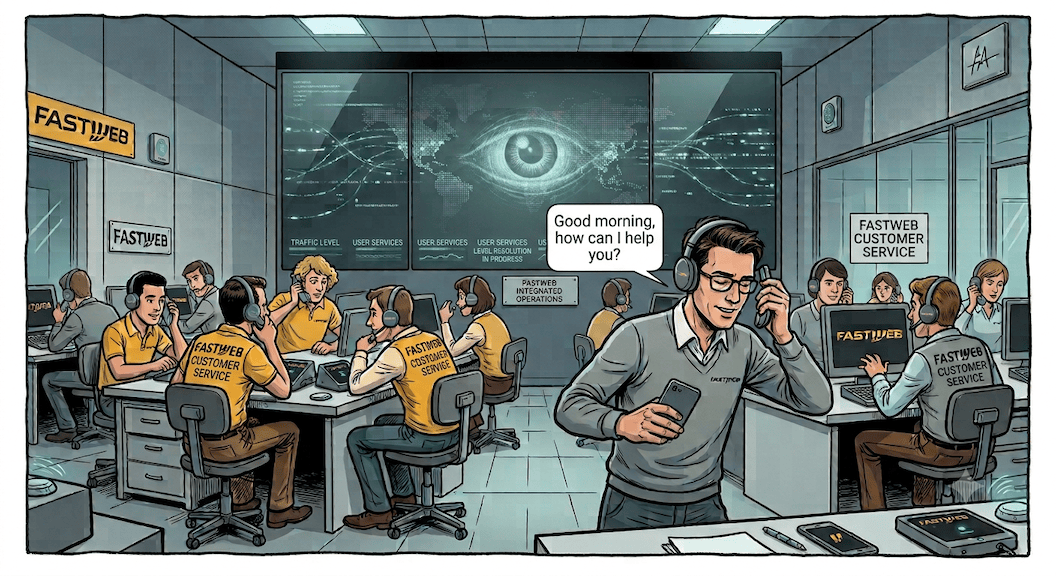 – Image generated by Google Gemini.
Until the last time I needed it, Fastweb had virtually flawless customer support: quick to respond and capable of resolving issues swiftly. Now, it’s mostly useless.
But Fastweb is just one example. Something similar has happened to me in recent months with Amazon and Google as well, and it wasn’t a pleasant experience at all. If this is the future that awaits us, please let me off.
-
Something I rule out right away, as it would have led me to lose all my custom settings. Because yes, the NeXXt is the only router on Earth that doesn’t allow to save its configuration to a file. ↩︎
-
This cannot be translated into english. Aruba is a small island located in the southern Caribbean Sea. However, “rubare” means “to steal” in Italian. ↩︎
-
From the novel by Joseph Heller, made famous by the paradoxical principle: “Anyone who is crazy can ask to get out from flight missions, but anyone who asks to get out from flight missions is not crazy.” ↩︎
