 IT
IT
 EN
EN

50 years with Apple
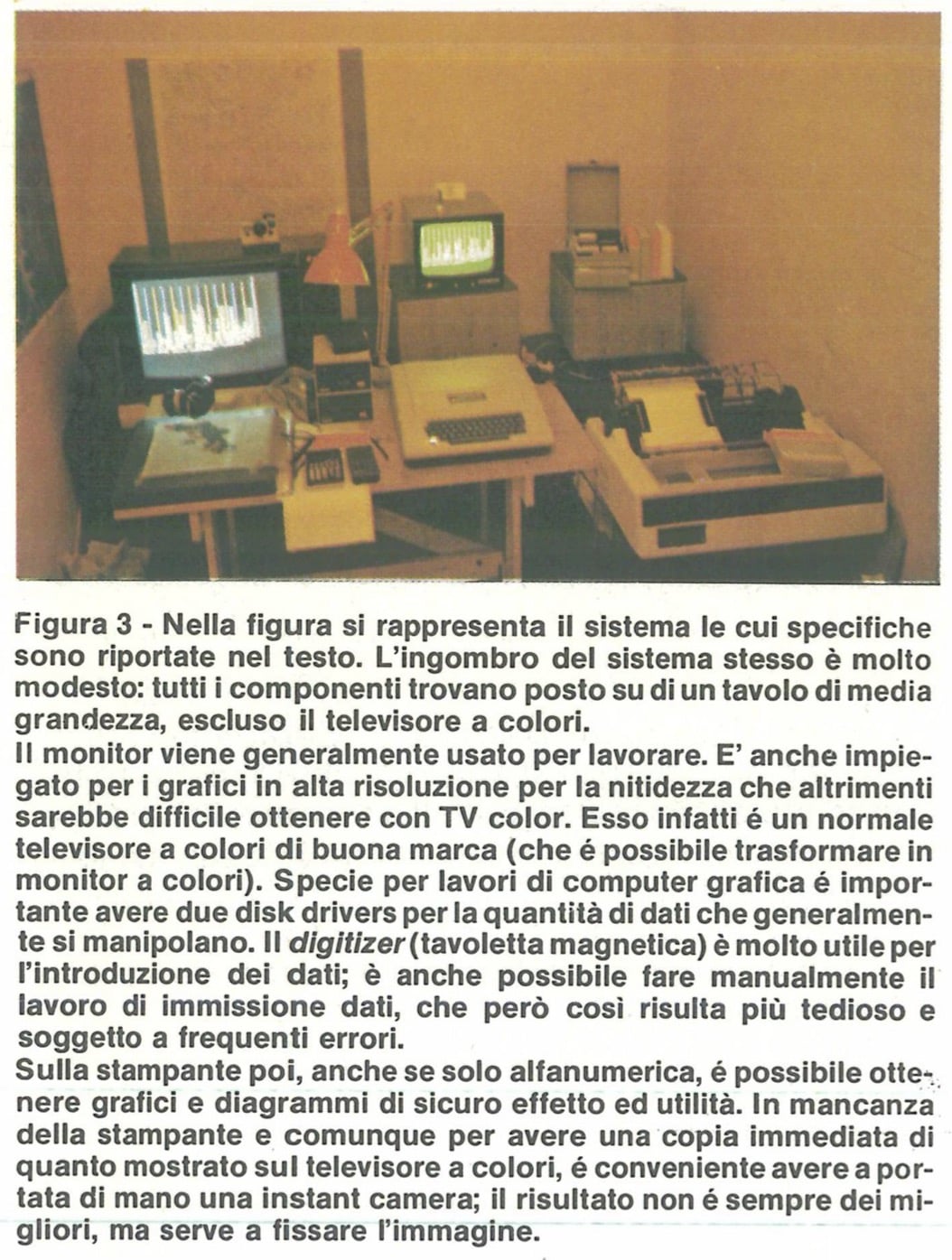
– The first image of an Apple II computer ever published in Bit, the most important Italian magazine dedicated to personal computers between the late 1970s and early 1980s (Bit no. 5, November–December 1979).
Fifty years ago, I was a spot-ridden high school student who wouldn’t have known about Apple until the early ’80s, when Bit —- the first Italian magazine dedicated to personal computers -— started featuring the first advertising pages dedicated to the Apple II computer.
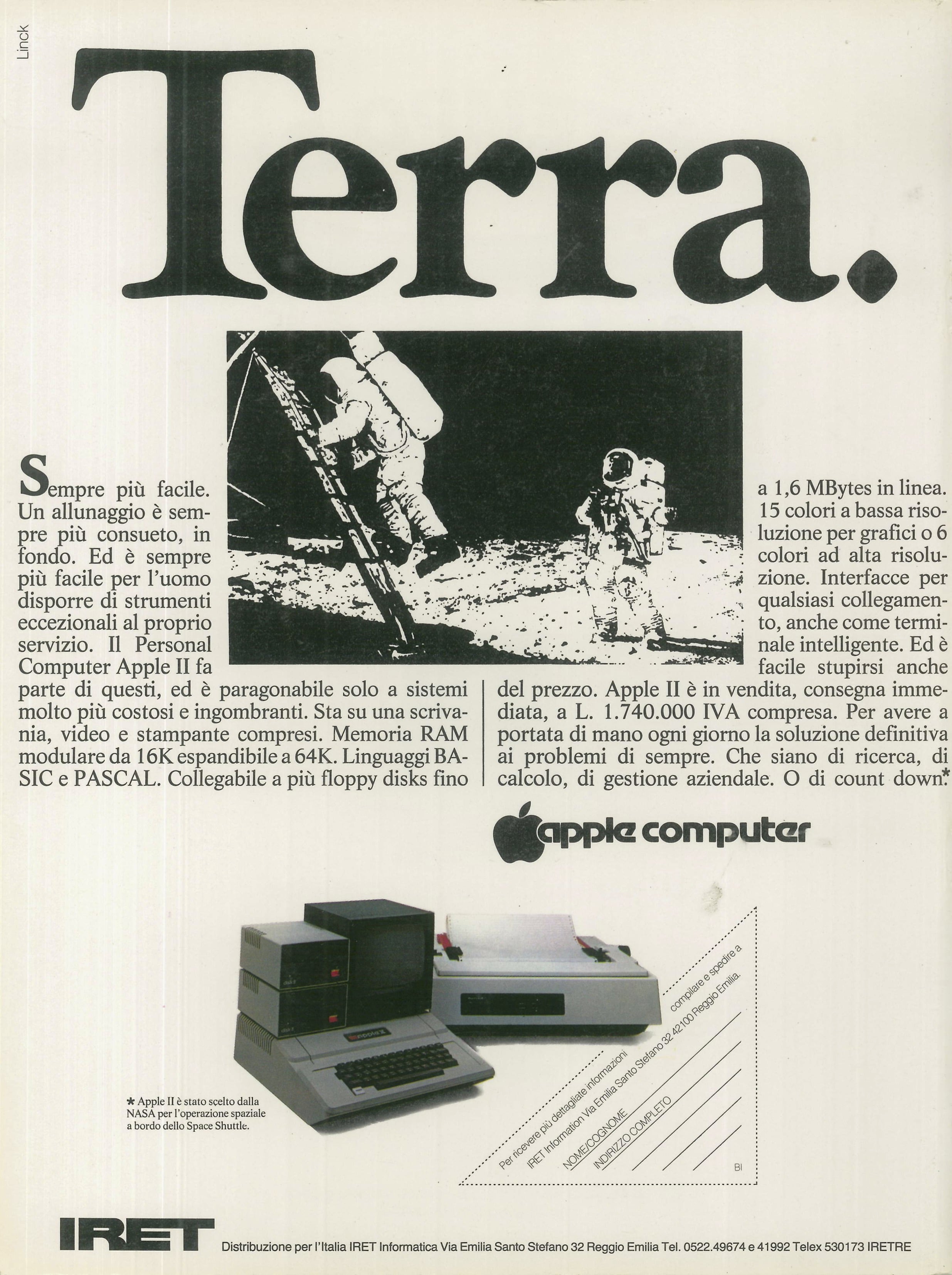
– First advertising page dedicated to an “Apple Computer” (Bit no. 6, February 1980, back cover).
In those years, most of the coverage of the Apple II came from Bit’s main competitor, MCmicrocomputer, which, from its very first issue in September 1981, dedicated significant space to the California company.
In 1981 an Apple II with 48 KB of RAM, an 11-inch monitor and a floppy disk drive cost 5 million lire, more than a small FIAT city car, just to give you an idea. An amount of money that was out of reach for a university student like me, who could afford at most a Commodore 64 bought after winning on Totocalcio.1
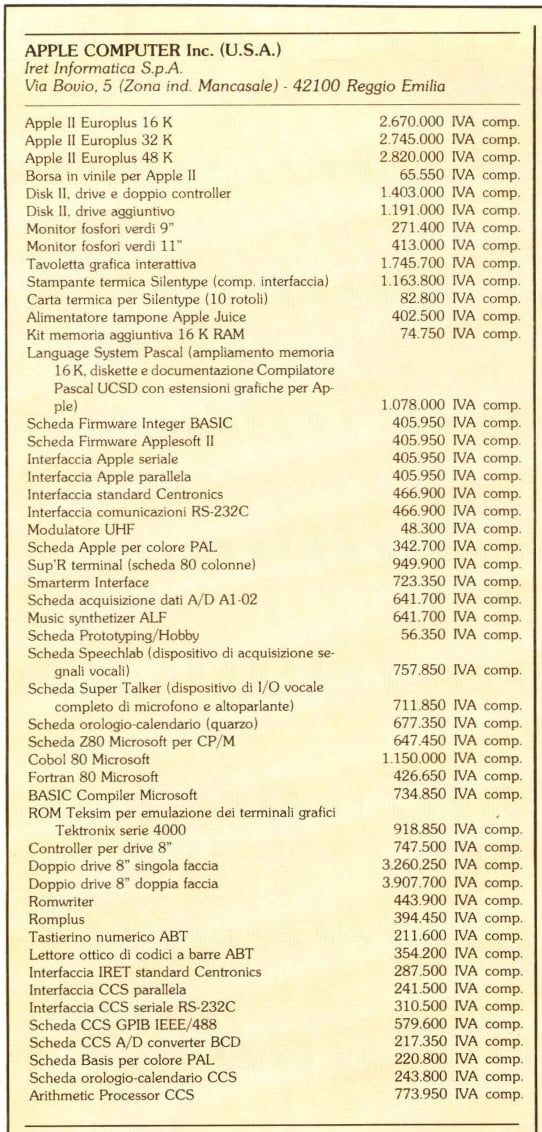
– The complete price list for Apple products from September 1981 (taken from MC Microcomputer no. 1, September 1981, page 84).
However, there were quite a few Apple IIs in the Physics Department, because they could be used to build the first automatic measurement instruments or to digitize images.2 You just had to wander through the various labs to find one, and if you were lucky you could also use it when it was free.
One of the first Macintosh 128K arrived soon. I only managed to use it briefly, as it was stolen after a couple of days.
Shortly later, at my first conference, I noticed that Ken Gray, one of the most prominent speakers, had used a Macintosh computer to prepare both the article and the slides. Among a hundred participants, all with texts written on typewriters and images glued on, his work stood out and was immediately noticeable. The Mac sparked immediate sympathy between us two, so much so that he asked me to move to Chicago to work with him. But I had already accepted going to the Physikalisch-Technische Bundesanstalt (PTB) in Germany, and preferred to keep my word.
It was precisely at PTB that the turning point came in terms of Apple products. Besides sophisticated instrumentation and one or two older Macs, my measurement laboratory housed a Macintosh II, the first expandable Mac (at last!), a true workstation that could rival the much pricier Sun and DEC models. It had plenty of expansion options, which was great! I don’t remember if the Macintosh II was connected to a system for acquiring and processing images for a microscope, which was truly state-of-the-art at the time (once back in Italy, I spent years trying to create a pale imitation of it).
But I remember very well that it had an analogue-to-digital conversion card installed, which could be used to digitize measurements on our samples. This card arrived together with the first version of LabVIEW, the first visual programming language, which for that reason ran exclusively on the Macintosh. For various reasons we used the card little, but LabVIEW immediately became the favorite pastime of mine and a Danish colleague (and friend). In the evenings, when no one was around, we would spend hours using LabVIEW for the most absurd things, the further they were from the original purposes of the language, the better.
The Macintoshes in the lab were set up to use German, and System 6 at that time didn’t support multiple users and languages. But despite my German being very poor (very poor, actually) I managed to use the Mac without too many problems because I remembered the position of the menu items that I had seen in manuals or magazines. Compared to the proprietary Unix system localized in German that I was forced to use occasionally, it was truly another world!3
Back home, my Apple winter began. That lasted until the dawn of the new millennium. Apple computers had become incompatible with everything: keyboards and mice for PCs didn’t work on Macs and vice versa. The same applied to RAM or video cards. And also to more sophisticated stuff that I used every day, like data and image acquisition cards or instrument control cards. Even transferring a file via floppy from a PC to a Mac tested the patience (and stubbornness) of a saint.
Then came Mac OS X.
In the early ’90s I had discovered Unix, mostly because it was the only way to manage to do some rather complicated numerical calculations.4 So when Linux arrived, I immediately jumped on the bandwagon and started using it everywhere.
Technically Linux was awesome, but the graphical aspect was, shall we say, somewhat limited. Therefore, when I saw an iBook G3 “Snow” with Jaguar in a shop display and read in Macworld that the new operating system was based on BSD Unix, I knew I had to get one.
The same happened with the iMac G4: I saw it, fell in love with it and bought it immediately. And for weeks colleagues came to the office, admired the monitor and started looking for the computer… 😂.
Since then, and it’s been almost twenty-five years, I’ve always used Apple products: Macs, iPods, iPads, iPhones, Apple Watches, I’m surely forgetting something. After all, they work (almost) always, and even the most technology-resistant family members can use them without any problems. They’re elegant and, although they cost somewhat more than competitors’ products, they also last much longer. It wouldn’t make sense to change, at least for now.
Sure, Apple has recently made some questionable decisions, such as macOS Tahoe and Liquid Glass, the imminent discontinuation of Rosetta, the introduction of paid versions of Pages, Numbers and Keynote (not to mention Freeform), the growing restrictions on third-party applications, and the Siri debacle. Not to forget the restructuring of System Settings, which has made them difficult to use, even for someone like me who needs them almost every day.
However, until Apple decides to prevent the installation of third-party applications also on macOS, as happens (not always) rightly on iOS and iPadOS, it will be difficult to leave the mother ship. After all, just as in a marriage with its ups and downs, fifty years spent almost always hand in hand are not easily forgotten.
So many, many, many happy returns to Apple for the next fifty years!

– Fonte: Ray Hennessy su Unsplash.
-
If you compare the price of the base Apple II reported in this image with that of the advertisement on Bit, you’ll notice that in less than two years the price of the base Apple II had increased by a whole million lire (roughly 1,000-1,500 euros today) due to the rampant inflation of those years. ↩︎
-
It was the era of transition from human digitizers, who spent their lives bent over huge images that they digitized by hand, to semi-automatic digitization systems, which in the simplest cases were almost always Apple IIs. ↩︎
-
All
shellcommands were localized in German, so the standardwhoamicommand, that shows the name of the logged-in user, becamewobinich↩︎ -
PCs were too slow. As if that wasn’t enough, and despite the threatening signs I left around, some colleagues persisted in turning off the PC on which I was running simulations overnight. They didn’t want to “waste electricity”, they said 😱. ↩︎
